
Written by: Tushar Katheria, Founder & Lead Counsel, Katheria Sports Law Offices-India
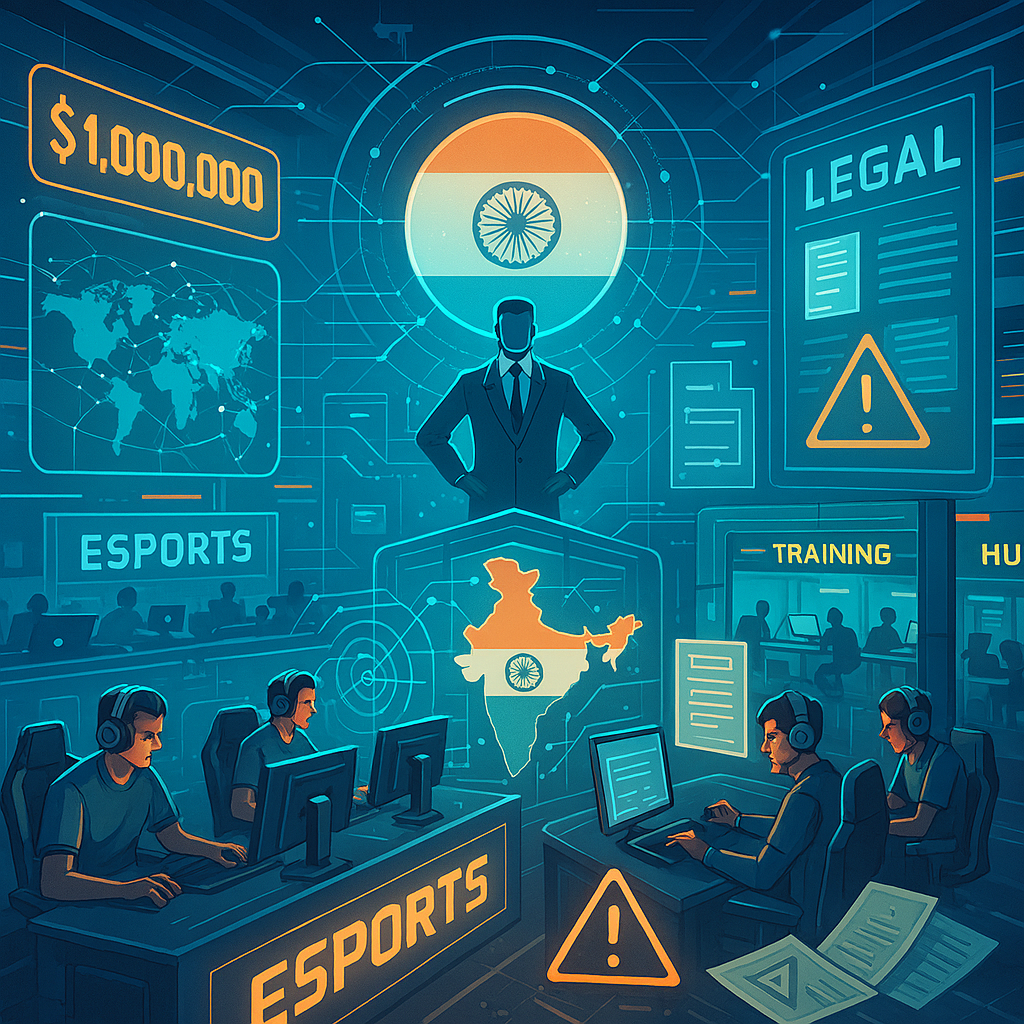
The Indian Parliament has introduced the Promotion and Regulation of Online Gaming Bill, 2025 in the Lok Sabha. This proposed legislation marks the most ambitious attempt yet to bring clarity, structure, and oversight to a rapidly expanding sector that includes eSports, casual and social gaming, educational games, and the highly controversial domain of real-money online gaming.
For stakeholders in the eSports industry — teams, organizers, investors, and players — the Bill carries significant opportunities as well as notable risks. At Katheria Sports Law Offices, where we work closely with eSports organizations, we believe it is essential to parse the provisions carefully and assess how this legislation could reshape the future of the industry.
The Promise of the Bill
- Formal Recognition of eSports: For the first time, the law explicitly distinguishes eSports from “online money games.” Under the Bill, eSports are defined as organized, skill-based competitions governed by pre-set rules and recognized under the National Sports Governance Act, 2025. This is a watershed development: it elevates eSports to the status of legitimate sport rather than treating it as a subset of casual online gaming. This recognition opens the door to integration within national sporting policy, eligibility for government support, and greater respectability in the eyes of sponsors, educational institutions, and even parents who may have previously viewed gaming with scepticism.
- Institutional Support and Infrastructure: The Bill envisions training academies, research centres, innovation hubs, and public awareness campaigns to support the growth of eSports. By embedding eSports within formal structures, the government is signalling that it sees long-term value in nurturing this industry. This will likely attract both public and private investment, which is critical for scaling India’s eSports ecosystem to global standards.
- Central Regulatory Authority: Currently, gaming regulations in India are fragmented across states, often leading to inconsistent outcomes. The Bill proposes the creation of a central regulatory authority with the power to register, categorize, and oversee online games. For eSports, this is particularly beneficial as tournaments frequently involve players from multiple states. A uniform national framework can reduce uncertainty, standardize compliance requirements, and promote smoother operations.
- Stronger Consumer and Player Protections: The Bill is motivated by concerns over the harms of real-money gaming — addiction, financial losses, fraud, and mental health risks. Its provisions aim to protect young and vulnerable users from exploitative practices such as manipulative algorithms and misleading advertising. While these concerns primarily target money gaming platforms, the emphasis on responsible digital practices could spill over positively into the eSports sector by reinforcing integrity, transparency, and player welfare.
The Pitfalls and Concerns
- Overbroad Definitions and Risk of Misclassification: One of the most pressing issues is the definition of “online money games.” The Bill bans any game played for stakes or deposits in expectation of monetary returns. While eSports is explicitly carved out of this definition, ambiguities remain. Many legitimate eSports tournaments require entry fees to fund prize pools. Unless clearly exempted, such formats risk being misclassified as “money gaming,” exposing organizers to severe penalties.
- A Ban Rather Than Regulation of Money Games: Unlike global best practices, where real-money gaming is licensed and regulated (e.g., the UK Gambling Commission), the Bill opts for blanket prohibition. While this addresses social harms, it may drive such platforms underground or offshore, creating enforcement challenges and inadvertently harming India’s credibility as a gaming hub. For eSports, the concern is collateral damage: investors and sponsors may hesitate to enter the space if the regulatory environment appears hostile or unclear, even though eSports is not gambling.
- Heavy Penalties and Compliance Burdens: The Bill prescribes imprisonment up to five years and fines up to ₹2 crore for violations. Although intended for money gaming operators, the lack of detailed classification criteria means eSports organizations could be caught in the regulatory crossfire. The burden of compliance will fall heavily on startups and mid-sized organizations that may not have the resources for continuous legal oversight.
- Advertising Restrictions and Sponsorship Risks: Section 6 prohibits advertisements promoting online money games. While aimed at gambling-style platforms, there is a grey area for sponsorships in eSports. If a tournament partners with a brand that also has interests in gaming apps offering monetary returns, regulators may scrutinize or even restrict such tie-ups. This could have chilling effects on sponsorship revenue, a vital lifeline for many eSports organizations.
- Extraterritorial Reach and Global Collaboration: The Bill applies even to online money games operated from outside India but accessible within its borders. While this closes loopholes for offshore operators, it raises practical challenges for international eSports partnerships, where cross-border events and prize money are common. Questions around taxation, compliance, and enforcement will need careful navigation.
The Honest Middle Ground
It is clear that the Bill reflects a dual ambition:
- To promote and legitimize eSports and social gaming as engines of innovation, skill development, and economic growth.
- To eliminate the risks of online gambling that have led to public health crises, financial distress, and in extreme cases, links to criminal activity.
The honest reality is that in pursuing these dual goals, the Bill succeeds in creating a long-awaited framework for eSports but may have gone too far in its blanket prohibition of money games. This all-or-nothing approach risks casting shadows of uncertainty on legitimate competitive gaming.
Implications for the eSports Industry
For eSports stakeholders, the Bill is a double-edged sword. On the one hand, recognition, support, and institutional legitimacy are major victories. On the other, the risks of misclassification, sponsorship challenges, and compliance burdens cannot be ignored.
The immediate tasks for eSports organizations will include:
- Structuring tournaments to ensure entry fees and prize pools are clearly separated from any form of wagering.
- Registering with the Authority once it is constituted, and proactively engaging with it to shape guidelines favorable to the sector.
- Reevaluating sponsorships to avoid associations that might attract regulatory scrutiny.
- Building compliance systems for transparency in operations, player protection, and responsible promotion.
International Best Practices and Recommendations
While India’s proposed approach is ambitious, it is not happening in a vacuum. Other jurisdictions have already grappled with similar challenges in online gaming and eSports. Their experiences offer valuable lessons:
- United Kingdom – Regulation over Prohibition
- The UK operates under the Gambling Act, 2005, enforced by the UK Gambling Commission (UKGC).
- Instead of banning real-money gaming, the UK regulates it through licensing, strict consumer protection rules, and transparency requirements.
- For eSports, the UK has taken a clear stance to distinguish competitive skill-based gaming from gambling, ensuring tournaments can have entry fees and prize pools without being misclassified.
- Lesson for India: Rather than blanket prohibition, consider a tiered licensing model for real-money gaming while carving out explicit safeguards for eSports.
2. United States – State-Level Experimentation
- The US does not have a uniform federal law on online gaming; instead, states regulate individually.
- Some states (e.g., New Jersey, Nevada) allow regulated online gambling, while others prohibit it.
- eSports betting is slowly being legalized under strict oversight in certain states, while eSports tournaments themselves are treated as skill-based competitions and not gambling.
- Lesson for India: While central uniformity is useful, India could retain state flexibility for experimental models — for example, sandbox regimes in progressive states to test innovative compliance structures.
3. European Union – Player Protection First
- EU member states vary in their gaming regulations, but the European Commission emphasizes player safety, data protection, and responsible gaming principles.
- Some countries (e.g., Germany, France, Spain) operate under strict licensing frameworks with limits on advertising, mandatory player verification, and anti-addiction tools.
- The EU also funds eSports initiatives under its digital innovation and youth engagement policies, recognizing the industry’s cultural and economic value.
- Lesson for India: Incorporate player welfare measures, such as mandatory age verification, anti-addiction warnings, and grievance redressal mechanisms, alongside promotional support for eSports.
Recommendations for India
Drawing from these international models, India could refine the Bill in the following ways:
- Explicit Safe Harbour for eSports
- Clearly state that entry fees + prize pools in eSports competitions do not constitute gambling or money gaming.
- This will protect organizers from misclassification risks.
- Shift from Prohibition to Regulation for Real-Money Games
- Adopt a licensing regime rather than outright bans, similar to the UK.
- This will generate tax revenue, enable monitoring, and reduce the black-market risk.
- Player Protection Framework
- Mandate age verification, cooling-off periods, self-exclusion tools, and transparency in algorithms to protect vulnerable users.
- Encourage mental health awareness campaigns in partnership with gaming companies.
- Advertising and Sponsorship Clarity
- Provide clear guidelines to separate legitimate eSports sponsorships from gambling promotions.
- Encourage brand partnerships in education, technology, and youth development.
- Sandbox and State-Level Pilots
- Allow certain states to operate regulatory sandboxes to test innovative eSports policies before scaling nationwide.
- This balances central oversight with flexibility for experimentation.
- International Collaboration
- Harmonize Indian rules with global eSports federations and digital trade agreements, making it easier for Indian teams and players to compete internationally without legal conflicts.
Conclusion
The Online Gaming Bill, 2025 is a bold step forward. By learning from international models and incorporating regulatory flexibility, India can strike a balance between protecting citizens and empowering the eSports industry. If executed with precision, India has the opportunity to become not just a fast-growing market but a global leader in eSports governance and innovation.
At Katheria Sports Law Offices, we believe the Bill, if fine-tuned with these recommendations, could provide the foundation for a safe, thriving, and world-class eSports ecosystem in India.
📌 This article is part of our ongoing insights series on sports law and digital regulation. For tailored guidance on compliance and strategy, reach out to our team.
